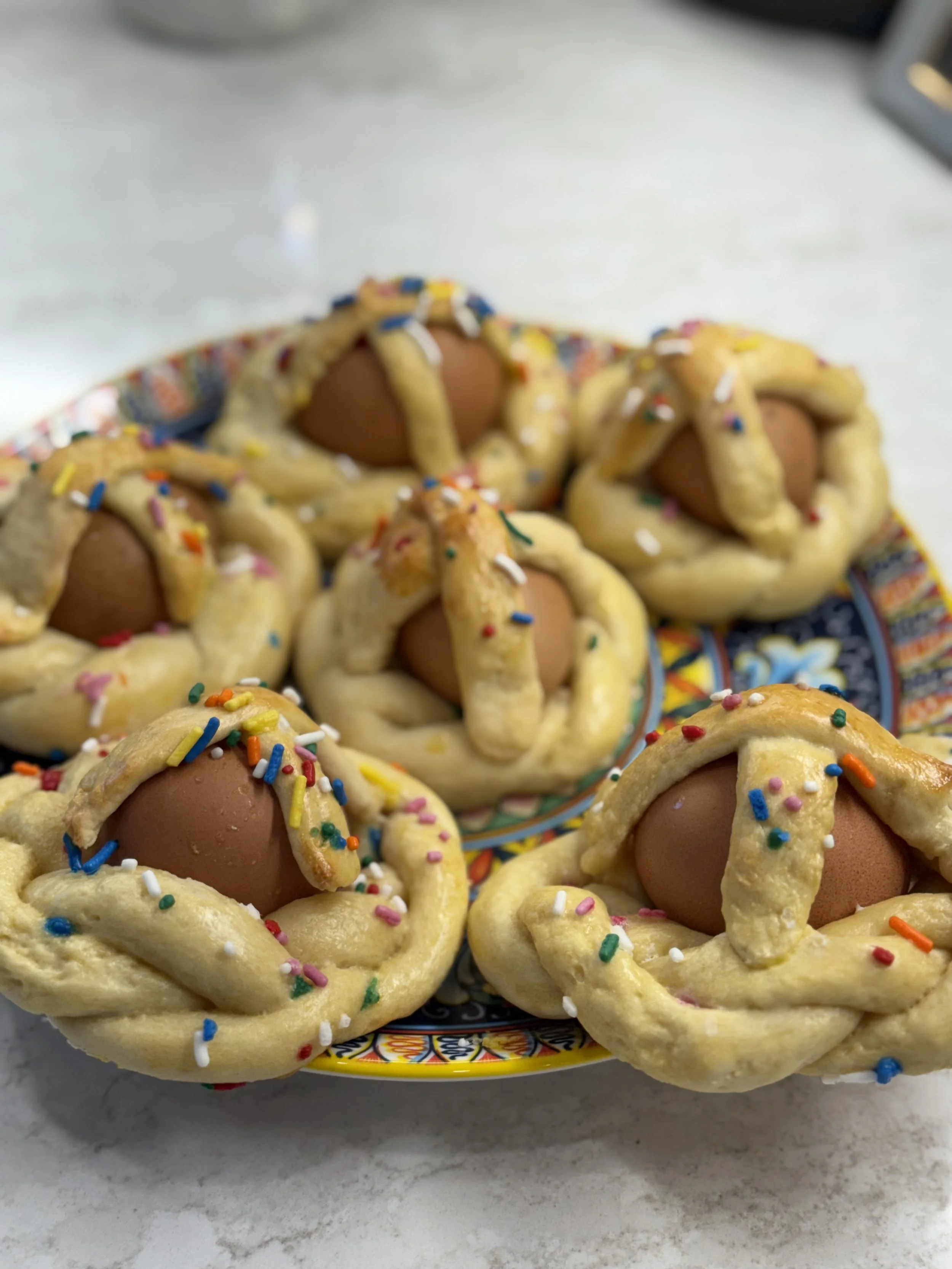
Cuddura cu l’Ova
In Sicily, Easter is not just a holiday. It is a celebration of renewal, family, and deeply rooted traditions that stretch back thousands of years. One of the most beautiful and symbolic foods tied to this time is cuddura cu l’ova, a rustic sweet bread with whole eggs baked right into its shape.
The word cuddura comes from the ancient Greek kollura, meaning a ring-shaped bread. This reflects Sicily’s long and layered history, where Greek, Arab, and Italian influences all left their mark on the island’s food and culture.
Traditionally, these breads were made at home in the days leading up to Easter. Families would shape the dough into meaningful forms like hearts, baskets, or crowns. Each shape carried its own symbolism, often representing love, abundance, or faith. The eggs, placed raw into the dough before baking, would cook in the oven and become a powerful symbol of life, rebirth, and the resurrection.
In many towns, cuddura cu l’ova was given as a gift, especially to children or godchildren. Each family had its own variation, its own shapes, and its own way of decorating with colorful sprinkles or sesame seeds.
What makes this dish so special is its simplicity. It is not overly sweet or delicate. It is rustic, humble, and deeply connected to the land and the people who made it. Like many traditional Sicilian foods, it tells a story of making something meaningful out of simple ingredients.
Today, cuddura cu l’ova continues to be a symbol of Easter across Sicily and in Sicilian communities around the world. Making it at home is more than just baking. It is a way to connect with history, tradition, and the generations that came before.
Recipe
Ingredients
For the Dough
3 cups all-purpose flour
½ cup sugar
1 teaspoon baking powder
Pinch of salt
2 eggs
½ cup milk
¼ cup olive oil or melted butter
Zest of 1 lemon
For Decoration
4 whole eggs (raw, in shell)
1 egg for egg wash
Sprinkles or sesame seeds
Jordan almonds for garnish (optional)
Instructions
Preheat oven to 350°F (175°C).
In a large bowl, combine the flour, sugar, baking powder, and salt.
Add the eggs, milk, olive oil, and lemon zest. Mix until a dough forms.
Transfer to a lightly floured surface and knead for about 5 to 8 minutes until smooth. The dough should be soft and slightly tacky but not sticky.
Divide the dough into portions. Roll into ropes and shape into circles, braids, or traditional forms.
Place a raw egg into each shape and secure it with two strips of dough crossed over the top.
Brush the dough lightly with beaten egg and add sprinkles or sesame seeds.
Bake for 25 to 30 minutes until golden.
Allow to cool for about 15 to 20 minutes before adding any decorative Jordan almonds.
Serve slightly warm or at room temperature.
Notes
For a more traditional rustic version, the baking powder can be omitted, resulting in a denser texture.
If the dough feels too sticky while kneading, add flour one tablespoon at a time until it becomes manageable.
Letting the dough rest for 10 to 15 minutes will help relax it if it becomes too elastic while shaping.
The eggs will cook fully in the oven, similar to hard-boiled eggs.
