Pasta alla Trapanese
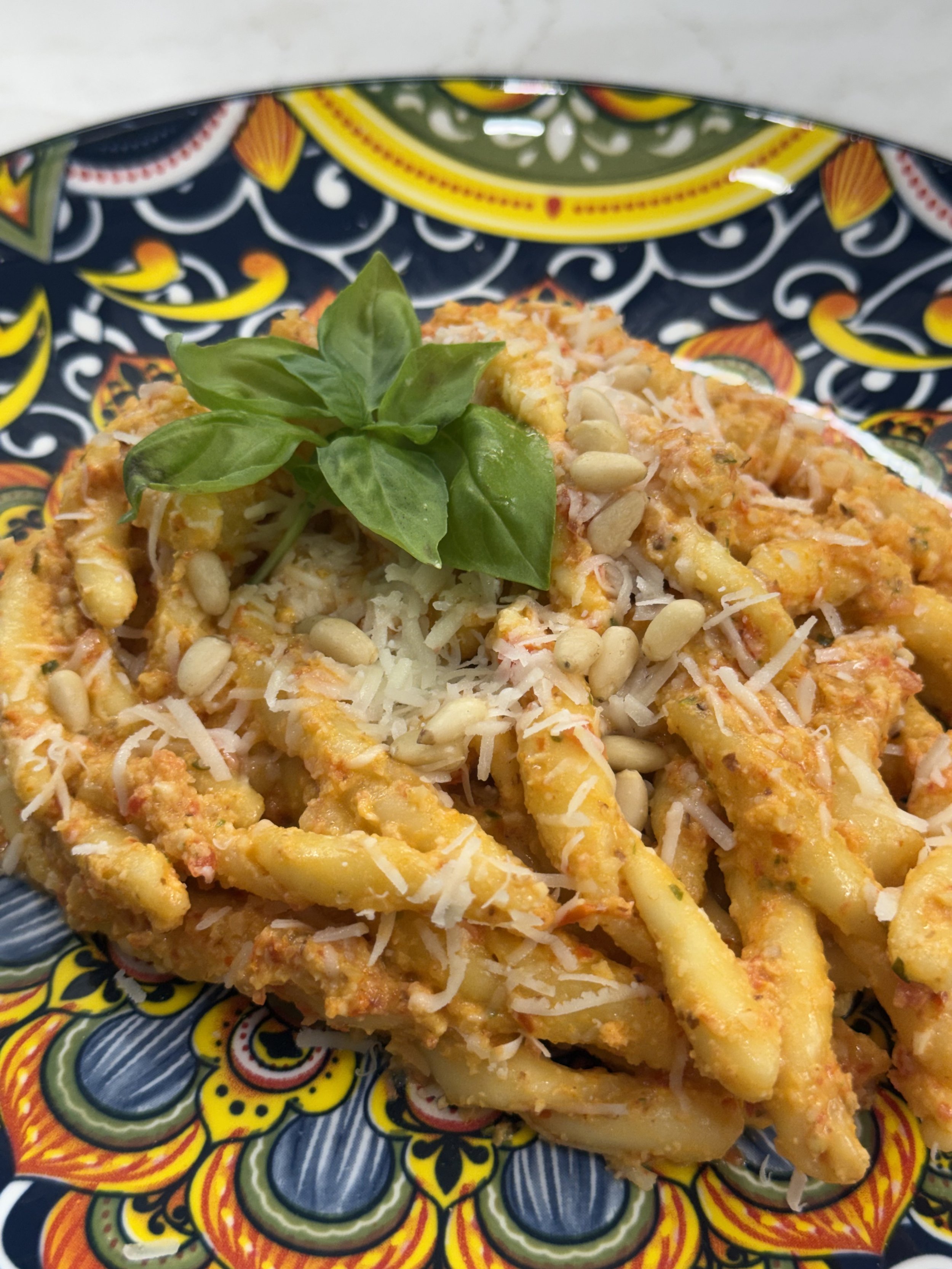
Pasta alla Trapanese
There are few places where Sicily’s position at the crossroads of the Mediterranean is more apparent than Trapani. Sitting at the island’s western edge, looking toward North Africa, the city spent centuries welcoming sailors, merchants, ingredients, and ideas from across the sea. Pasta alla Trapanese is a delicious reminder of that history.
The heart of the dish is pesto alla Trapanese, or agghiata Trapanisa: a fresh, uncooked sauce of tomatoes, almonds, basil, garlic, olive oil, and traditionally Pecorino. Unlike the familiar green pesto of Liguria, the Trapanese version is creamy, slightly sweet from ripe tomatoes and almonds, fragrant with basil, and intensely summery.
Tradition connects its origins to Genoese sailors and merchants who stopped at the port of Trapani while traveling Mediterranean trade routes. They brought with them versions of agliata, the garlic-based sauces that eventually contributed to the development of Ligurian pesto. Sicilian cooks adapted the idea using ingredients abundant in western Sicily, which most importantly featured almonds.
The story, however, unfolded over centuries. Tomatoes could only become part of the dish after they arrived in Europe from the Americas in the sixteenth century and gradually entered southern Italian cooking. What we now recognize as pesto alla Trapanese therefore represents several different chapters of Sicilian history layered together: Mediterranean garlic sauces, Sicily’s ancient relationship with almonds and durum wheat, contact with Genoese sailors, and finally the arrival of the tomato from the New World.
And then there is the pasta.
Pesto alla Trapanese is traditionally paired with busiate, the beautiful twisted pasta associated with western Sicily. Their name is generally connected to the busa, a thin plant stem traditionally used to form them. Strips of durum-wheat dough were wrapped around the stem and rolled to create their characteristic elongated spiral.
The pasta belongs to a much older Sicilian tradition. In 1154, the geographer Muhammad al-Idrisi described the Sicilian town of Trabia as an important producer of itriyya, a dried wheat pasta exported throughout the Mediterranean. Although that pasta was not modern busiate, the account demonstrates just how deep Sicily’s tradition of durum-wheat pasta making runs.
Busiate are particularly well suited to pesto alla Trapanese. Their twists capture the roughly crushed almonds and pieces of tomato, allowing the uncooked sauce to cling to every piece of pasta.
That combination creates something quintessentially Sicilian: a dish born not from one moment or one culture, but from centuries of exchange across the Mediterranean.
Fresh tomatoes. Almonds. Garlic. Basil. Pecorino. Durum wheat. Olive oil.
Simple ingredients, but an enormous amount of history.
Recipe
Serves 4:
Ingredients
For the Eggplant:
1 lb (450 g) busiate
1 lb (450 g) very ripe tomatoes
¾ cup (100 g) blanched almonds
1 large handful fresh basil leaves, about 20–25 leaves
1–2 cloves garlic
½ cup (120 ml) extra-virgin olive oil, plus more as needed
½ cup (50 g) finely grated Pecorino Siciliano or Pecorino Romano
Fine sea salt, to taste
Freshly ground black pepper, to taste
Extra chopped almonds, pine nuts, basil, and Pecorino for serving
Salt and pepper to taste
Instructions
Use a food processor or an immersion blender. Pulse the garlic and almonds first. Add the basil and pulse briefly, followed by the tomatoes. Slowly add the olive oil while pulsing just until combined.
Do not puree it completely smooth. Pesto alla Trapanese should retain some texture from the almonds and tomatoes.
Stir in most of the Pecorino and season with salt and black pepper to taste.
Bring a large pot of generously salted water to a boil.
Add the busiate and cook until al dente according to the package directions. Before draining, reserve about 1 cup of the pasta cooking water.
Place the pesto in a large serving bowl.
Add the hot drained busiate directly to the pesto and toss vigorously. Add a splash of reserved pasta water if necessary to loosen the sauce and help it coat the spirals.
The pesto itself should not be cooked. The heat of the freshly drained pasta gently warms the tomatoes, basil, almonds, garlic, and olive oil while preserving their fresh flavor.
Finish with additional Pecorino, a scattering of chopped almonds, fresh basil, and a drizzle of good extra-virgin olive oil.
Serve immediately.
